
Why blockchain exists
Why this matters
Week 0 gave you vocabulary and a tool map. This week turns them into a working model, and it starts with the question everything else depends on.
Most people meet blockchain through prices, tokens and hype, which is a bad introduction because it skips the actual problem the technology was built to solve. If you don't understand that problem, everything afterwards — wallets, gas, contracts — is arbitrary rules to memorise.
This is the only part of the week with no software to install. It's the one that makes the rest of the programme make sense.
Learning objectives
By the end of this page you should be able to:
- Explain what problem blockchains were designed to solve, without using the word "crypto"
- Describe the difference between a system with an operator and one without
- Give one example where removing the operator genuinely helps, and one where it doesn't
A short history: why “Web3”?
Before asking what problem a blockchain solves, it helps to know why people call this space Web3. The name is a historical shorthand for a changing web, not a technical label that every application must satisfy.
Web1 — mostly read
Early websites mainly published information for people to browse. “Mostly read” is a useful summary, not a claim that every early website was completely static.
Early web
Web2 — read + write
Platforms made accounts, user-generated content and social interaction normal. On Instagram, you create the content, but the platform controls the database that says what exists and who may access it.
Platform web
Web3 — read + write + user-controlled state
Some important state can be controlled with keys and maintained on a shared network. If you hold ETH, a wallet app is an interface rather than the ledger; another compatible wallet can still access the same on-chain state. This does not mean every application detail is on-chain.
Blockchain-oriented web
| Aspect | Web1 | Web2 | Web3 |
|---|---|---|---|
| Familiar picture | An early university, news or company website | Instagram, TikTok or YouTube | A wallet holding ETH, or a DApp using on-chain assets |
| Important state | The website owner publishes the pages | The platform database and account system | Keys plus a shared network for selected on-chain state |
| Digital value | External payment rails | Platform-mediated payments | Native or tokenised programmable assets |
| Main trust model | Site operator | Platform operator | A mix of users, networks, contracts and operators |
The web labels describe broad tendencies, not strict eras or universal rules. The Web2 point is technical control rather than a universal legal claim about who owns content. The Web3 point is that selected state can be user-controlled and shared without making every application detail on-chain.
Public blockchain data is typically replicated across many network participants, so one company cannot unilaterally rewrite or remove the shared record. But this does not mean that all Web3 data is on-chain or permanent: applications still use frontends, databases, storage providers and companies, and a website or off-chain file can disappear while an underlying on-chain record remains.
Ethereum co-founder Gavin Wood articulated a “Web 3.0” decentralised-web vision in 2014, motivated in part by reducing how much people must rely on trusted central intermediaries. “Web3” later became the broader industry term used around blockchain-based applications, assets and ownership.
Naming caveat — Web3 vs Web 3.0
The blockchain-oriented Web3 idea and the older Semantic Web / “Web 3.0” idea are not necessarily the same concept. You do not need Semantic Web theory for this course; just avoid treating the shared name as proof that the two visions are identical.
Read + write + own is shorthand
Picture this as a change in where some state lives and who can authorise it, not a promise that users own every piece of application data or that Web3 replaces Web2. A modern application can use a Web2 database and login alongside a wallet and selected on-chain state.
That is why people started calling this Web3. It also leaves the question that leads directly into this page: if important shared state is not controlled by one platform, who maintains the shared record and decides which changes are accepted? Blockchain is one answer to that problem.
Core
Operator → problem → answer
- Operator — When you send money through a bank app, you ask the bank to update its ledger. That is efficient, reversible and usually useful, but everyone relies on the operator to stay solvent, honest and available.
- Problem — If many independent parties keep a shared record with no single controller, whose copy is right when they disagree? Without an operator checking its records, even double-spending becomes a hard coordination problem.
- Answer — A blockchain is a shared record that many independent computers maintain together, with rules that let them agree on what is true without any of them being in charge.
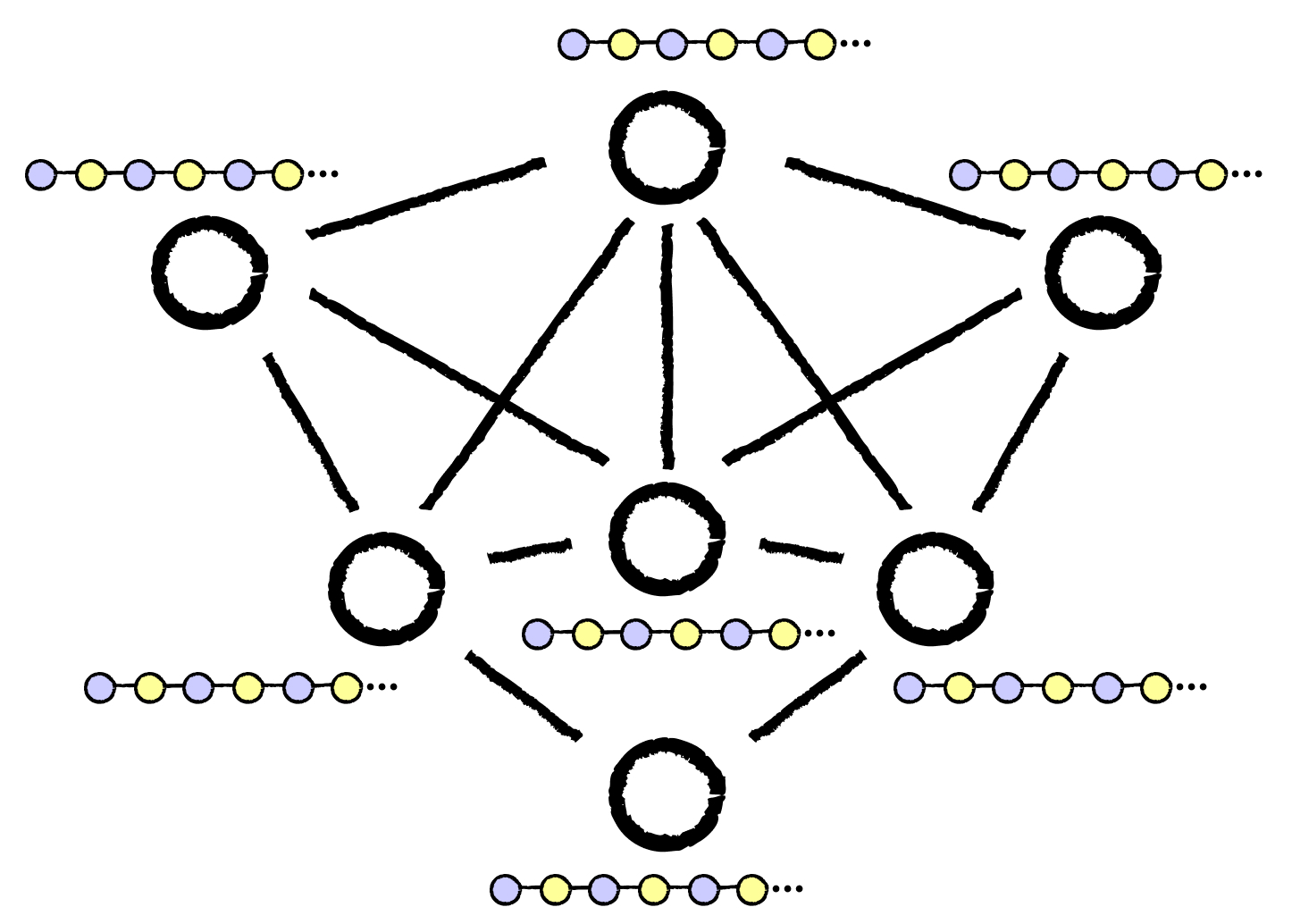
Three things make it work:
| Element | What it does |
|---|---|
| Shared ledger | Everyone holds the same record, and anyone can read it |
| Rules everyone checks | A change is only valid if it follows the rules, and every participant verifies this independently |
| Agreement mechanism | A way to settle what gets added next, even when participants don't trust each other |
That third element is consensus, and it's Part 3.
What it costs
This is where most introductions stop, and it's the part worth being honest about
Removing the operator is expensive. Thousands of computers redoing the same work is slower and costlier than one company running one database. Nobody can reverse a mistake for you. Nobody can restore your access if you lose your keys.
So the useful question is never "should this be on a blockchain?" — it's:
Decision rule
Is the operator actually a problem here?
| Case | Verdict |
|---|---|
| Your university's exam records | The operator is fine. NTU is trusted, accountable, and reversing an error is a feature |
| Sending money abroad through four intermediaries who each take a fee and a day | The operator is more of a problem |
You'll meet plenty of projects that got this question wrong. Being able to ask it is most of what separates someone who understands this space from someone repeating what they heard.
Landscape
You'll hear these words in the same breath as blockchain. You don't need to be able to build any of them — just place them on the map.
- Bitcoin — the first working example of this idea, built mainly for payments and deliberately narrow in scope
- Ethereum — a shared record that can also run programs, trading more flexibility for more complexity
- Consensus — the agreement mechanism that decides which valid history the network follows. Part 3
- Crypto assets — values tracked by a blockchain, with different rights and risks depending on the asset. Part 5
Worked example
Two people agree Ann pays Ben $50.
Ann's bank reduces her balance, increases Ben's, and records it.
- If the bank goes down, nothing happens
- If it makes an error, it can fix it
- Both parties trust the bank
Ann announces to a network that she's sending 50 to Ben, signed with a key only she holds. Participants check she has 50 and hasn't already spent it. They agree to add it to the shared record.
Once final, it becomes part of the public chain history, and there is no central operator Ann can ask to reverse the transfer.
Notice the trade in both directions
Harder: no help if Ann sent it to the wrong address.
Easier: Ben needs no permission from anyone to receive it, and no central ledger operator can simply reverse a valid native-asset transfer.
Further exploration — optional, not assessed
- Bitcoin whitepaper — the original 2008 proposal. Nine pages. Section 1 alone is worth reading, and states the double-spend problem more plainly than most modern explanations
- ethereum.org — Web3 — how the same idea extends beyond payments
Sources and attribution
- ethereum.org — Web3 — Reuse (CC BY 4.0), adapted
- ethereum.org — What is Ethereum — Reuse (CC BY 4.0), adapted
- ethereum.org — Intro to Ethereum — Reuse (CC BY 4.0), adapted
- Bitcoin whitepaper — Link, referenced only
- Web3 Internship Handbook — Reuse (permission granted, LXDAO); distributed-network visual adapted from its blockchain basics materials
- Gavin Wood — Less-techy: What Web 3.0 Is — Link, referenced for the 2014 Web 3.0 origin and decentralised-web framing