Welcome, GitHub and the platform
You are starting the Academy Foundation: a beginner-first path through a subject where the most common beginner experience is drowning in vocabulary, and the second most common is losing money to something avoidable. This programme is built to prevent both.
Foundation Pilot · Sep–Oct 2026
The current pilot covers Week 0 through Week 4 only. The Week 4 Track Selection Card is the final pilot output. Weeks 5–8 are shown in the Handbook as the next stage of the Academy, but they are not required for Foundation Pilot participants. The full Week 0–8 programme begins with Cohort 1 in January 2027. The W5–W6 Deep Dive and W7–W8 Proof of Work milestones are in development for Cohort 1 · January 2027.
Today is housekeeping — three accounts and a clear picture of how the Academy works. It is the least interesting page in the handbook and the one that saves you the most time later.
Learning objectives
- Create a GitHub account and explain what a repository, commit and README are for
- Access the Academy platform and Telegram group, and say what each is used for
- State how missions are reviewed and what happens when one is rejected
- State the two rules that apply to every week of this programme
Core
How the Academy works
Weeks 1–4 are the same for everyone. They build a shared map of blockchains, wallets, Ethereum, smart contracts and the wider industry. You do not choose a specialism yet, because you cannot sensibly choose one before you know what is out there.
For the full programme, Weeks 5–6 are the Deep Dive. At the end of Week 4, you select Builder or Researcher and stay on that capability path through W8, then build transferable skills through reviewable Part tasks. Your domain and eventual PoW topic can still evolve; W7 combines scope definition with producing an MVP / V1. Foundation Pilot learners stop after Week 4; the Deep Dive and later Proof of Work milestones are shown here as the next stages of the full Academy.
The weekly rhythm
Each Foundation week has a handful of short pages and one Anchor Mission. The full programme then adds six 100-point Deep Dive tasks in Week 5, six more in Week 6, and the W7–W8 Proof of Work milestones. There is no separate W5 or W6 weekly submission: each Part task is that week's progress evidence.
| Item | Details |
|---|---|
| Anchor Missions | One per Foundation week, Weeks 1–4; 100 points each |
| Deep Dive tasks | Six Part tasks in W5 and six in W6; 100 points each |
| PoW checkpoints | W7 Scope + MVP / V1 200, W8 Refine + Final PoW 200 |
| Total | 2,000 points for the full programme |
| Week 0 | No mission, no points |
| Review outcomes | Completed or Rejected — nothing in between |
| Rejected | Comes back with specific feedback. Resubmit as many times as you need |
| Deadlines | None. The weekly pace is a recommended rhythm |
Read that last row twice
There is no penalty for taking longer. A rejection is not a fail — it means something specific is missing, you will be told exactly what, and you send it again.
Foundation Pilot completion
For Foundation Pilot participants, the four Foundation Anchor Missions are the relevant missions. Week 4 is the final required week: complete the Track Selection Card / Anchor Mission, then stop here. The W5–W6 Deep Dive and W7–W8 Proof of Work milestones belong to the full Cohort 1 programme.
The Foundation pages are longer than their missions require. That is on purpose: richer content, lighter assessment. Read the Core sections properly, skim Landscape, and treat Further Exploration as optional. In Deep Dive, each Part task is embedded in the learning rather than added as extra homework.
Reading levels
| Level | What it means | Assessed? |
|---|---|---|
| Core | You should be able to explain or demonstrate this | Yes |
| Landscape | You should recognise it and roughly place it | No |
| Further Exploration | Optional depth | No |
If you are short on time, Core is the part that matters.
The three accounts you need
Where developers — and increasingly researchers, analysts and product people — keep their work in public. In this programme it serves two purposes: you will read project code and documentation on it from Week 2, and your final Proof of Work will live on it.
It is also, bluntly, a portfolio. A GitHub profile with real work on it is worth more to an employer in this industry than most certificates.
Where cohort operations happen: your application, mission submissions, review feedback, points and progress.
The handbook and the platform have a clean division of labour:
| Area | Handbook | Platform |
|---|---|---|
| Learning material | ✅ canonical | short operational copy |
| Foundation Anchor Mission instructions | ✅ canonical | short operational copy |
| Deep Dive Part-task requirements | ✅ canonical | short operational copy |
| Proof of Work milestone requirements | ✅ canonical | short operational copy |
| Submitting work | — | ✅ |
| Review and feedback | — | ✅ |
| Points, progress, leaderboard | — | ✅ |
If the two ever disagree about what a mission requires
The handbook is correct.
Where the cohort actually talks. Questions, stuck moments, announcements, and the informal help that makes the difference between giving up on a broken setup and fixing it in four minutes.
Use it. The single strongest predictor of finishing a programme like this is whether you asked for help the first time you got stuck.
Public Web3 chat groups attract impersonators
Academy organisers will never DM you first asking for a seed phrase, a private key, a wallet connection, a payment, or an "urgent verification".
Scammers copy real names and profile pictures. Verify in the main group before acting on any direct message. See Part 4.
The two rules
These hold throughout the Academy and have no exceptions
1. Testnet only for transactions and wallet actions. Any Academy activity that sends a transaction, deploys a contract, performs a state-changing wallet action, or otherwise requires funds or an on-chain signature must use testnet only. Some lessons may ask you to inspect public mainnet data in a block explorer without connecting a wallet or sending anything. Testnet coins are free and worth nothing. No mission will ever require real money or a wallet holding real assets. If a mission appears to ask this, stop and ask in the group.
2. Nobody asks for your keys. No reviewer, organiser or committee member will ever ask for your seed phrase or private key. Anyone who does is not who they claim to be, regardless of what their profile says.
Landscape
Terms you will see on GitHub this week. Week 4 covers GitHub properly.
| Term | What it is |
|---|---|
| Repository ("repo") | A project folder with its full history. It gives collaborators one place to read, change and review the work |
| Commit | One saved change, with a message explaining what and why. Commits let you inspect how the project reached its current state |
| README | The front page of a repository, written in Markdown. It tells a new reader what the project is and how to use it |
| Markdown | Plain text with light formatting marks — this handbook is written in it. GitHub turns those marks into readable pages |
| Issue | A tracked task, bug or question. It keeps context and discussion attached to the work |
| Pull request | A proposed change, opened for review before it is merged. Reviewers can discuss and test it in one place |
| Fork | Your own copy of somebody else's repository. It lets you experiment or propose changes without directly changing the original |
Guided walkthrough
Create your GitHub account
Go to github.com and choose Sign up. Use an email address you will still have after you graduate.
Pick a username you would be comfortable putting on a CV — it appears in every URL of every project you touch, and changing it later breaks existing links.
Verify your email. You should now be able to reach your profile at
github.com/your-username.Turn on two-factor authentication
Settings → Password and authentication → Two-factor authentication. An authenticator app is stronger than SMS. GitHub requires 2FA for accounts that contribute code, so doing it now avoids being locked out later.
Students
The GitHub Student Developer Pack is free with an NTU email and includes tools you will meet later. Optional, but it costs five minutes.
Make your first repository
From your profile choose Repositories → New. Name it
blockchain-ntu-academy, set it Public, tick Add a README file, and choose Create repository.Edit the README and commit
Open
README.md, choose the pencil icon, and replace the contents:# Blockchain@NTU Academy Learning notes and progress for Blockchain@NTU Academy. ## What I want from this programme - Understand how blockchains actually work - Build something small I can showChoose Commit changes, write a short message like
docs: add README, and commit. You should now see your text rendered as a formatted page, and a commit count of 2.That is the whole GitHub loop: edit, describe the change, commit. Everything else is a variation on it.
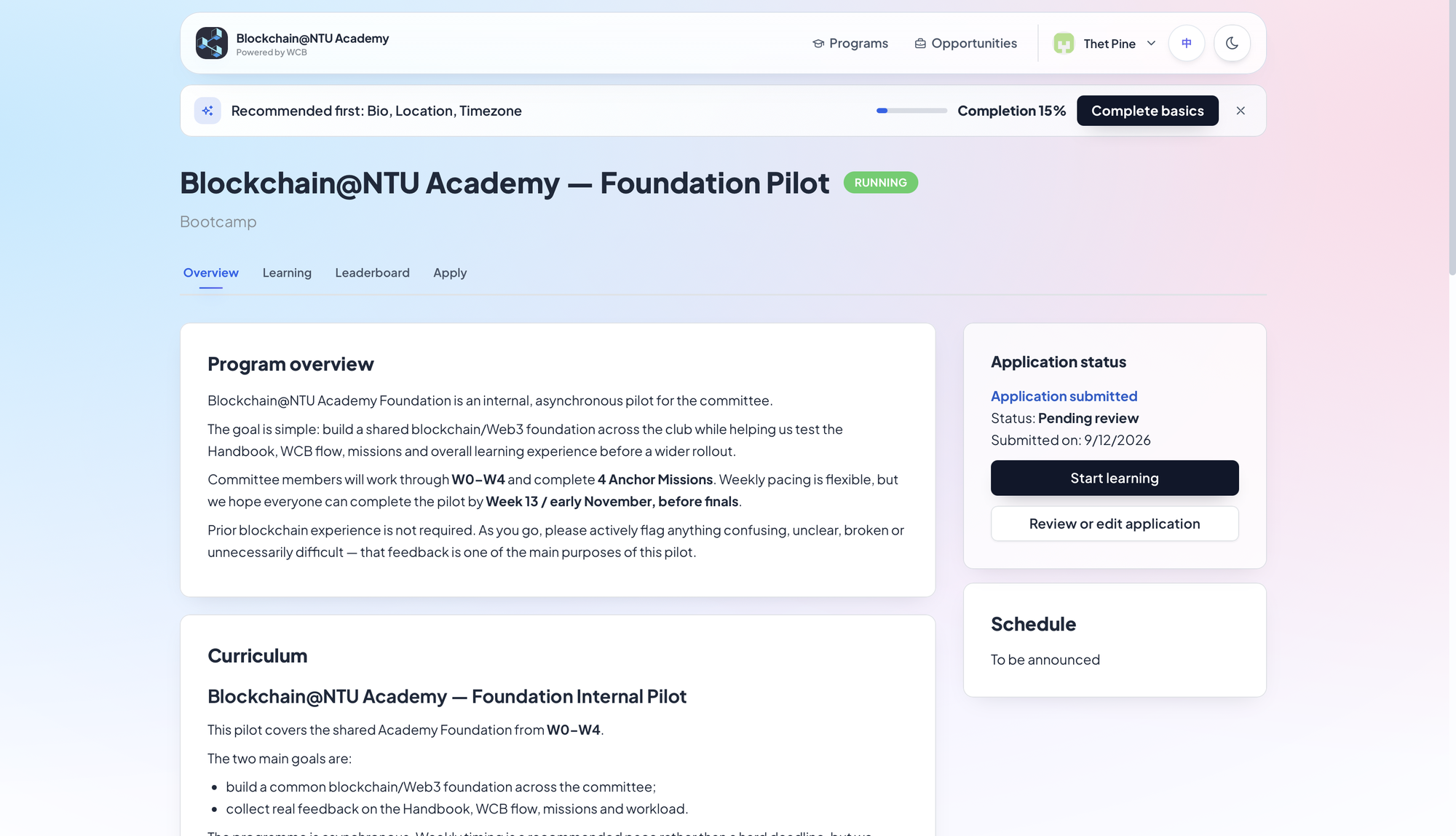
Open your learning page on Web3CareerBuild (WCB)
If your Academy application has been approved, open the Learning panel in WCB.
You should see the Academy learning page with the recommended reading order, handbook links, and your current task. Use this page as your starting point each week. The handbook remains the source of truth for the learning material and task requirements.
Join the Academy Telegram group
Use the invite in your acceptance email, and post a one-line introduction: what you study, and one thing you want to understand by the end of the Foundation.
Worked example
Here is what a good first week of setup looks like, and what it is worth.
Someone joining with no technical background creates a GitHub account under a sensible username, turns on 2FA, and pushes one commit to a README. Total time: about fifteen minutes. Nothing about it is impressive.
In the full programme, eight weeks later, that same repository holds their Week 3 contract, their Week 4 Track Selection Card, Deep Dive work and final Proof of Work with a README explaining what they built and what they would do next. The commit history shows it accumulating week by week.
The value is not any single commit
It is that there is a visible, dated trail of someone learning in public — which is the thing this industry actually reads.
Further exploration — optional, not assessed
- GitHub Skills — short interactive courses. "Introduction to GitHub" takes about 20 minutes
- GitHub Docs — Hello World — the official walkthrough, covering branches and pull requests
- Markdown basic syntax — worth ten minutes, because you will write Markdown every remaining week
Sources and attribution
- GitHub Docs — Creating an account — Reuse (CC BY 4.0), adapted
- GitHub Docs — Hello World — Reuse (CC BY 4.0), adapted
- GitHub Docs — About README files — Reuse (CC BY 4.0), adapted
- GitHub Skills — Link, referenced only