
Public, private and consortium chains
Week 1 described one kind of blockchain: anyone can read it, anyone can participate, nobody is in charge. That is the kind this programme mostly deals with, and it is not the only kind.
Banks, shipping consortia, hospital networks and government agencies also run blockchains — with membership lists, access controls and named participants. To someone who has only met public chains this looks like missing the point entirely.
It is neither a contradiction nor a mistake
It is a different point on the same set of trade-offs. Being able to place any system on that spectrum is what today gives you.
Learning objectives
- Distinguish public, private and consortium blockchains by who can participate
- Explain permissionless vs permissioned, and why it is a separate axis
- Name what a permissioned system gains and what it gives up
- Judge, for a given use case, which model actually fits
Core
Two questions, not one
People collapse these into a single spectrum, and it causes real confusion.
| Question | Axis |
|---|---|
| Who can see, use or access the system? | Open ↔ Restricted |
| Who can help operate, validate or maintain it? | Permissionless ↔ Permissioned |
Ethereum is public and permissionless. A bank's internal chain is private and permissioned. A consortium chain might publish some data publicly while restricting who validates.
Public, private and consortium are useful shorthand for common combinations of these choices, not a second set of axes. Real systems can mix open and restricted access in more nuanced ways.
The three models
These three models are practical combinations of the two questions above.
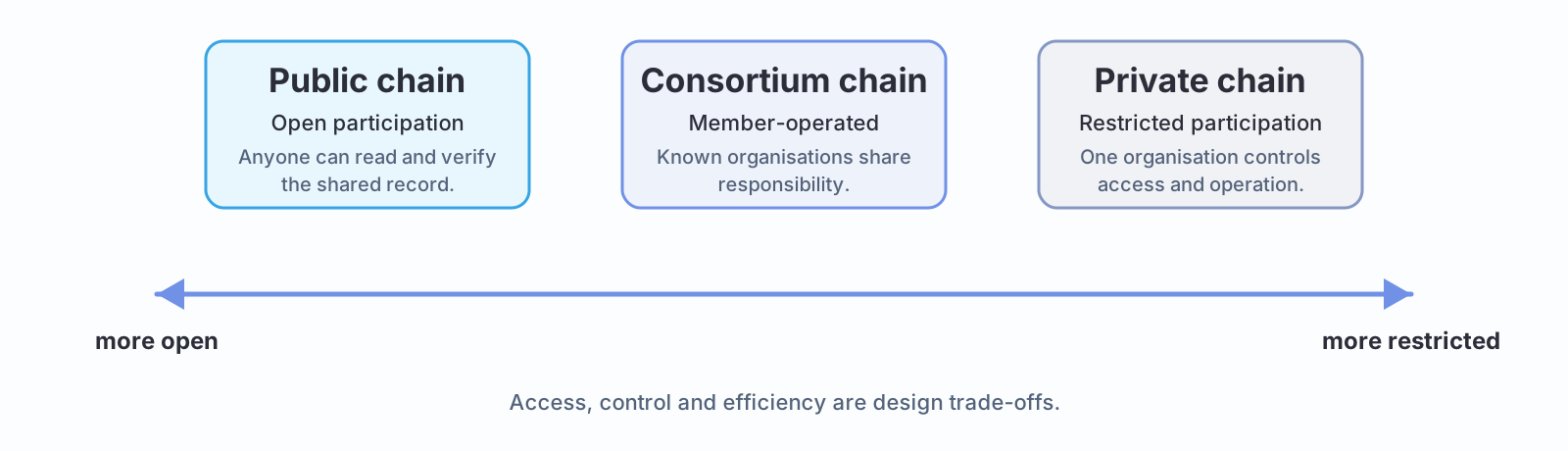
Anyone can read, transact, and run a node. No gatekeeper.
Examples: Bitcoin, Ethereum, Solana
| Aspect | Details |
|---|---|
| Gains | Censorship resistance, no single trusted operator, independent verification, global from day one |
| Costs | Can be slower or more expensive; activity is typically public; mistakes may be difficult to reverse or correct |
| Use when | Participants do not trust one another and no acceptable operator exists |
One organisation controls who participates and what is visible. Often a single company across its own departments or subsidiaries.
| Aspect | Details |
|---|---|
| Gains | Can be faster, cheaper and more private; the operator can coordinate corrections |
| Costs | You are trusting the operator — the thing public chains exist to avoid |
| Use when | You want shared infrastructure and tamper-evident records inside a trust boundary that already exists |
The fair question to ask any private chain — out loud
If one organisation controls it, what does the blockchain give you that a well-run database with good audit logs would not?
Sometimes there is a genuinely good answer: shared write access across mutually suspicious internal parties, cryptographic auditability, easier reconciliation. Sometimes there is not, and the honest answer is that a database would have been fine.
Several organisations jointly operate the network. No single one is in charge, but participation is by membership.
Examples: trade finance networks, interbank settlement, supply chain consortia
| Aspect | Details |
|---|---|
| Gains | No single operator, accountable members, good performance and privacy where needed |
| Costs | Governance is genuinely hard — members must agree on rules, upgrades and admissions — and it is only as decentralised as its membership |
| Use when | Several organisations need a shared record, do not fully trust one another, but know and can hold one another accountable |
This is the model most enterprise blockchain work actually uses, and where much of the industry's non-crypto employment sits.
The trade-off, in one table
Every design decision on this page is one of five dials.
| Dimension | Public / permissionless | Consortium | Private |
|---|---|---|---|
| Openness | Anyone | Members only | One organisation |
| Control | No single organisation by design; protocol rules still matter | Shared among members | One organisation |
| Privacy | Typically public by default | Selective | Restricted to the organisation |
| Operator participation | Open under protocol rules | Members only | One organisation |
| Efficiency | Often lower than tightly controlled systems | Often higher than open participation | Can be optimised for throughput and coordination |
Read across any row
Openness and decentralisation often create trade-offs with efficiency and privacy. The operator-participation row is a rough description of the architecture, not an objective score. There is no configuration that maximises all five. Anyone claiming otherwise is selling something.
This is Week 1 Part 1's insight — removing the operator has a cost — generalised into a spectrum rather than a binary.
Choosing
Being willing to say "this should be a database" is a mark of competence
The most common mistake in this industry is starting at the bottom right when the honest answer was the top left.
Landscape
- Hyperledger Fabric — a widely used permissioned framework, with private channels between subsets of members. It can limit who sees or writes particular records
- Enterprise Ethereum — EVM-compatible deployments run under permissioned conditions. Familiar Ethereum tools can be used, but access is controlled by an organisation or consortium
- Sidechain — a separate chain connected to a main one, often with its own smaller validator set (Part 5). Its connection to the main chain does not automatically give it the same security
- Validator set — the group permitted to produce or confirm blocks. On a public chain participation is open under the rules; on a permissioned chain membership is controlled
- Node operator agreement — the contractual layer a consortium chain needs to define who runs nodes and what happens when someone fails. Public networks use protocol rules instead
- Hybrid designs — private execution with periodic commitments anchored to a public chain. This can keep business data private while making a checkpoint publicly verifiable
Worked example
Five ports and forty shipping companies want a shared record of container custody. Today each keeps its own system, and reconciling disputes takes weeks.
| Option | Verdict |
|---|---|
| Public chain | No. Container movements are commercially sensitive — competitors would read each other's volumes in real time. Fees and latency also poorly match millions of routine updates |
| Private chain, run by the largest port | No. Everyone else is now trusting a competitor to operate the record. The forty-first participant will ask why, and they will be right to |
| Consortium chain | Yes. Ports and carriers jointly validate. Members are known, accountable and contractually bound. Sensitive detail stays restricted; custody handovers are shared. No single participant can rewrite history alone |
And the honest check
Could this be a shared database run by an industry body? Genuinely, yes — and several such systems exist.
The argument for the consortium chain is that no member has to accept another's system as authoritative, and disputes are settled against a record none of them can unilaterally alter. That is a real argument. It is also a modest one — and it is the kind that survives contact with reality, unlike "blockchain will revolutionise shipping."
Further exploration — optional, not assessed
- ethereum.org — Enterprise Ethereum — EVM technology in permissioned settings
- Hyperledger Fabric documentation — the leading permissioned framework
- Find a real enterprise blockchain announcement and ask the database question of it. A genuinely useful habit
Sources and attribution
- ethereum.org — Enterprise Ethereum — Reuse (CC BY 4.0), adapted
- ethereum.org — Networks — Reuse (CC BY 4.0), adapted
- ethereum.org — Nodes and clients — Reuse (CC BY 4.0), adapted
- Web3 Internship Handbook — Reuse (permission granted); public, consortium and private chain visual adapted with permission