
How shared state works
Part 1 ended with a claim: many independent computers can maintain one shared record without any of them being in charge. That is easy to say and not at all obvious how to build.
Today is the machinery. Part 3 answers the remaining question — who decides what gets added next — but none of that makes sense until you know what is being added.
Learning objectives
- Describe what a transaction is and what makes one valid
- Explain what a block is and why transactions are batched
- Explain what a node does and why thousands of them exist
- Explain, without maths, how a hash makes tampering detectable
Core
State is just "how things are right now"
Strip away the jargon and a blockchain maintains one thing: state.
Address 0xAB…  →  4.2 ETH
Address 0xCD…  →  0.1 ETH, 300 USDC
Contract 0xEF… →  a list of who owns which NFT
A blockchain is a machine for changing that, by agreed rules, in a way everyone can verify. Only one thing changes state: a transaction.
Transactions
Imagine the shared record says Alice has 1 ETH and Ben has 0 ETH. Alice's wallet asks to send Ben 0.1 ETH. If the request is accepted, the next snapshot says Alice has 0.9 ETH and Ben has 0.1 ETH.
That signed request is a transaction: an instruction to change state. A payment is one kind of transaction. Others deploy programs, call functions, or grant permissions.
For now, focus on four ideas: who authorised the request, where it is going, what value it carries, and the signature. Data, nonce and fee fields will make more sense later as you work with contracts and transaction fees.
| Field | What it is |
|---|---|
| From | The address requesting the change |
| To | The recipient address, or a contract being called |
| Value | How much of the native asset to move, if any |
| Data | What to run, for a contract call. Empty for a plain transfer |
| Nonce | A counter, so the same transaction can't be replayed |
| Fee fields | What you'll pay for the work — Part 7, and Week 2 |
| Signature | Cryptographic proof the sender authorised this |
That last field carries the whole security model
No signature, no valid transaction. And crucially, the signature can be checked by anyone — without contacting the sender, and without any authority confirming their identity.
A transaction is valid if it is correctly signed, the sender has the balance, the nonce is right, and it obeys the rules. Every participant checks this independently. Nobody takes anyone's word for it.
Blocks
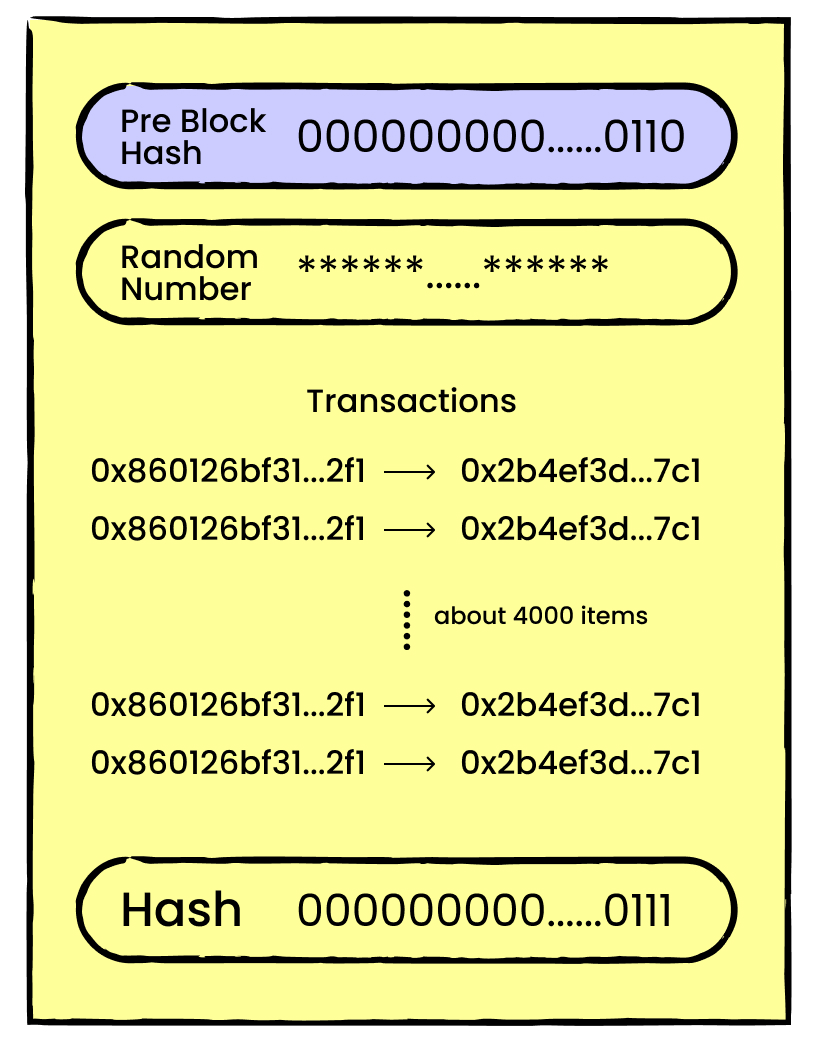
Transactions are gathered into blocks — a batch, plus a header, added as a unit. Two reasons, and the second is the interesting one:
| Reason | Why |
|---|---|
| Efficiency | Agreeing once on a batch of hundreds beats agreeing hundreds of times |
| Ordering | Order determines outcome. If an address holds 1 ETH and two transactions each try to spend it, which succeeds depends entirely on which comes first |
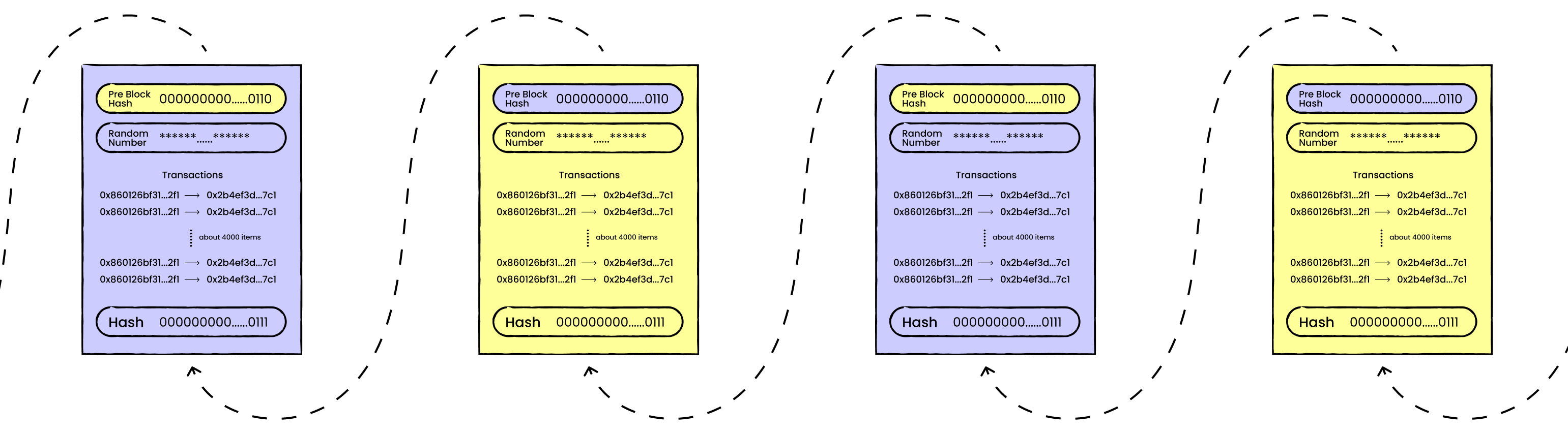
Ethereum produces a block roughly every 12 seconds. Bitcoin, roughly every 10 minutes. Week 2 covers why they differ.
Hashing, without the maths
A hash function takes any input and produces a fixed-length fingerprint.
"blockchain"   →  ef7797e13d3a75526946a3bcf00daec9fc9c9c4d51ddc7cc5df888f74dd434d1
"blockchain."  →  62cbcc24a6f9c60fdb8f32183cf3a10ab4b28d66aa8167043027a81d51a0b392
These are real SHA-256 values. You can check them yourself — on macOS or Linux:
printf '%s' 'blockchain' | shasum -a 256Three properties are all you need:
| Property | Why it matters |
|---|---|
| Same input, same output, always | Anyone can independently verify a hash |
| Any change, however tiny, changes the output completely | Tampering is detectable |
| There is no known practical way to recover the original input from the hash output | Reversing it is computationally impractical with current methods |
Now combine that with the chain of blocks.
Change one transaction in block 100 and block 100's hash changes. But block 101 stored the old hash as its "previous" field — so block 101 no longer matches. Fix block 101 and its own hash changes, breaking block 102. And so on, to the present, on every copy held by every participant worldwide.
What hashes do — and do not do
Hashes make tampering obvious: altering anything invalidates the links after it, publicly and quickly. They do not, by themselves, decide which history the network should accept. Consensus makes a rewritten history difficult to get accepted.

Alter the third block and its hash changes — so every link after it breaks. The damage runs forward, publicly, on every copy.
Two related terms, at recognition level
A digital signature uses related maths to prove a message came from the holder of a specific key without revealing that key. Part 6 returns to this.
A Merkle tree hashes transactions together in pairs so a whole block reduces to one fingerprint — and so you can prove one transaction is in a block without downloading the block. Further Exploration.
Nodes
A node is a computer running the network's software. For the Foundation model below, “node” means a validating/full node unless stated otherwise. Each one:
- holds a copy of the chain and current state
- receives new transactions and blocks and independently checks every rule
- discards anything invalid, no matter who sent it
- relays what's valid to its peers
The third point is the one to sit with
A validating/full node does not trust the block producer. It re-executes and re-verifies everything itself. An invalid block is not rejected by a committee — it is independently ignored by everyone at once, because every validating/full node checked.
This is also where Part 1's honesty about cost returns. Thousands of machines independently redoing identical work is the opposite of efficient. That redundancy is the product. It is what you are buying when you remove the operator.
At this point we can detect when a chain of blocks was altered. But imagine two different histories that are each internally valid. Which one should the network follow? Part 3 answers that question with consensus.
Landscape
- Full node — a computer that checks blocks and transactions itself and keeps the current state. It lets an operator check the chain without relying on the computer that produces blocks
- Archive node — a full node that also keeps older versions of the chain's state. It uses much more storage and helps explorers answer questions about the past
- Light client — checks selected information and proofs instead of storing the whole chain. It is easier to run, but depends more on the information it receives
- Mempool — the waiting room of submitted-but-not-yet-included transactions. Pending transactions can be visible before a block producer chooses their order
- Genesis block — block zero, the start of the chain. It gives participants a common reference for that network's history
- Fork — when a chain temporarily splits, or when its rules change. During a split, different participants may briefly see different histories
- Merkle tree — a way of combining many transaction hashes into one summary hash. That summary lets you prove a transaction was included without sending every transaction in the block
Worked example
Follow one transaction from your screen to a public blockchain record.
| Step | What happens | Who's involved |
|---|---|---|
| 1 | You request: send 0.05 ETH to Ben | You |
| 2 | Your wallet signs it with your private key | Your wallet, locally |
| 3 | It's broadcast to a node, which checks signature, balance and nonce | One node |
| 4 | Valid, so it's relayed to peers. It sits in the mempool | The network |
| 5 | A block producer selects it and includes it in a block | One producer |
| 6 | The block is broadcast. Every validating/full node re-verifies every transaction in it | Every validating/full node |
| 7 | Nodes apply it. Your balance drops, Ben's rises | Everyone |
Now the counterfactual. Suppose at step 5 the producer quietly edits your transaction to send 5 ETH to themselves instead.
The edit breaks your signature — and your signature is checkable by anyone holding your public address. At step 6, every validating/full node checks it, finds it invalid, and discards the entire block. The producer wasted their effort and gained nothing.
Nobody adjudicated. No authority intervened.
The block was rejected everywhere simultaneously because everyone verified independently.
In everyday language, this is why people sometimes use the word trustless: you do not have to rely on one authority's promise, because participants can check the rules for themselves. It does not mean that the system has no trust assumptions.
Further exploration — optional, not assessed
- ethereum.org — Blocks — full block structure
- ethereum.org — Transactions — every field, precisely
- ethereum.org — Merkle trees — how a block reduces to one hash. Genuinely elegant, entirely optional
Sources and attribution
- ethereum.org — Blocks — Reuse (CC BY 4.0), adapted
- ethereum.org — Transactions — Reuse (CC BY 4.0), adapted
- ethereum.org — Nodes and clients — Reuse (CC BY 4.0), adapted
- ethereum.org — Intro to Ethereum — Reuse (CC BY 4.0), adapted
- Web3 Internship Handbook — Reuse (permission granted, LXDAO); block-structure and block-to-blockchain visuals adapted from its blockchain basics materials