
Wallets, accounts and keys
Everything so far has been about the network. This is about you — how a person holds a position in a system with no accounts department, no password reset, and no way to prove who you are to anyone.
Almost every avoidable loss in this space traces back to one of the four things on this page
Read Week 0 Part 4 first if you have not.
Learning objectives
- Explain why a wallet does not contain your coins
- Describe the relationship between private key, public key, address and recovery phrase
- Explain the difference between signing and sending, and why signing can be dangerous
- Explain what a testnet is and why this programme uses one
Core
A wallet does not hold your money
The name is genuinely misleading, and the misunderstanding it causes is not harmless.
Your assets are entries in the blockchain's state — Part 2. They are not in an app on your phone. Delete your wallet software and your assets are entirely unaffected.
The correction
A wallet holds keys. Keys authorise changes to state. The assets never move off the chain, because they were never anywhere else.
Which is why reinstalling a wallet and entering your recovery phrase restores everything. Nothing was transferred. You just regained the ability to sign.
The four things, in order
They derive from one another in one direction only. That directionality is the entire security model.
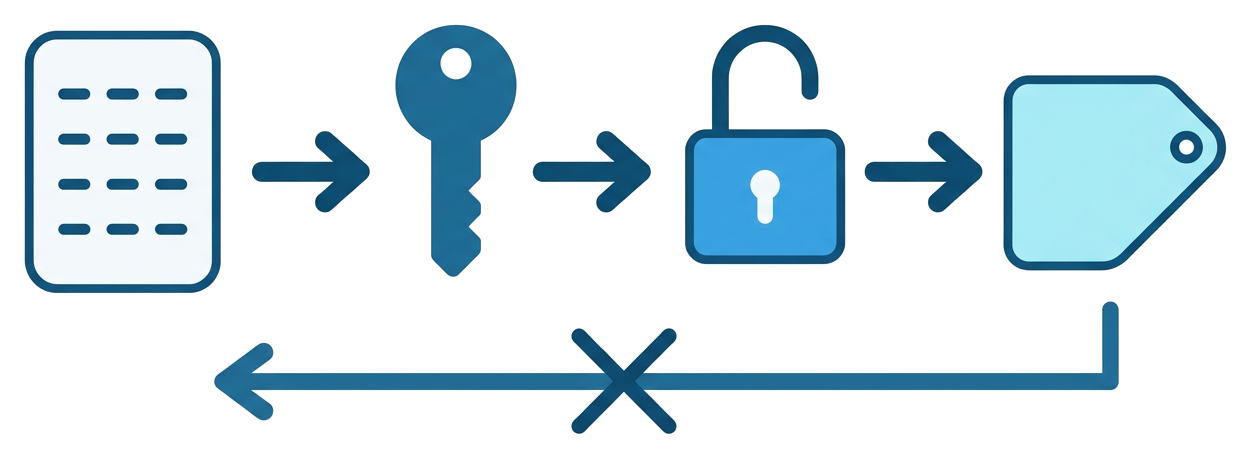
Left to right: recovery phrase → private key → public key → address. The crossed arrow is the point — recovering the original secret from the public information is computationally infeasible with current methods.
What these actually look like
The names are abstract, so here are complete documentation-only examples of their usual forms. The examples below illustrate each format independently; they are not one connected wallet.
Illustrative examples only
These are illustrative documentation placeholders created for this lesson only. They are intentionally malformed and are not valid wallet credentials. The examples are independent and do not form one wallet. Never import, fund, reuse, or treat them as real credentials. Never share a real recovery phrase or private key.
| Thing | Displayed placeholder | Real format / why this placeholder is malformed | Share it? |
|---|---|---|---|
| Recovery / seed phrase | harbor velvet cactus meadow orbit demo pebble maple canyon silver tulip notaword | Real concept: mnemonic words from a defined word list and checksum system. This placeholder intentionally contains invalid mnemonic-style words. | No — never |
| Private key | 0x8f2a91c4e7b35d6081fa246bc39e5a72d4c0187ef6b9a35142cd780ae59DEMO | Real format: 32 bytes = 64 hexadecimal characters, often with an optional 0x prefix. This placeholder contains non-hexadecimal characters. | No — never |
| Public key | 0x04a1b2c3d4e5f60718293a4b5c6d7e8f90123456789abcdef0123456789abcdef7bd2c4e6f80123456789abcdef0123456789abcdef0123456789abcdefDEMO | Real uncompressed-style format: 0x04 + 128 hexadecimal characters. This placeholder is deliberately corrupted and is not a valid public key. | Yes — public information |
| Public address | 0xA11CE0000000000000000000000000000000DEMO | Real format: 20 bytes = 40 hexadecimal characters after 0x. This placeholder is deliberately malformed and is not a valid Ethereum address. | Yes — this is the normal public identifier |
| Account component | What it is |
|---|---|
| Private key | A very large secret number. Whoever knows it can sign as you, permanently. Not like a password — a password is checked by a server that can reset it. There is no server here |
| Public key | Derived from the private key by one-way maths. Anyone can verify your signatures, while recovering the private key from the public key is computationally infeasible with current methods |
| Address | Derived from the public key by hashing it and representing the result as 20 bytes. This is what you share |
| Recovery phrase | 12 or 24 ordinary words that regenerate the private key — and every key in the wallet |
The recovery phrase is strictly more powerful than any single key
Anyone holding it holds every account in that wallet, forever, from anywhere.
No website, DApp, support agent, reviewer or Academy organiser should ever ask for it. The normal exception is when you deliberately restore or import your wallet into wallet software that you installed from a verified official source. Never enter it because someone sent you a link, DMed you, or told you to “verify”, “sync” or “unlock” your wallet.
Account, wallet, address
| Term | Precisely |
|---|---|
| Address | A public identifier for an on-chain account — 0x followed by 40 hex characters |
| Account | The address plus its on-chain state: balance, nonce, and code if it's a contract |
| Wallet | The software managing your keys and signing on your behalf |
One wallet typically manages many addresses, all derived from the same recovery phrase. That is why MetaMask shows "Account 1", "Account 2" from a single setup.
Ethereum has two account types, central in Weeks 2 and 3:
- EOA (Externally Owned Account) — controlled by a private key. What you have
- Contract account — controlled by its own code. No key or recovery phrase of its own; its code does not sign or submit an ordinary transaction by itself
Signing versus sending
The distinction that costs people the most money
Signing is local and free. Your wallet applies your private key to some data. Nothing touches the network, no transaction fee is paid, nothing appears on any explorer.
Sending is broadcasting a signed transaction, where the transaction consumes gas, a transaction fee is paid, and state can change.
So every transaction is signed, but not everything you sign is a transaction.
| You sign | What happens now | What can happen later |
|---|---|---|
| Login to a site ("prove you own this address") | Nothing on-chain | Normally nothing |
| A transaction to send 0.05 ETH | 0.05 ETH moves | Nothing further. Bounded |
An on-chain approval — an approve() transaction | Costs gas; sets an allowance on-chain | That contract can move your tokens at any future time |
| A signature-based permission | Nothing visible, often no gas | Someone else can submit it later to create the same permission |
The last two rows do the same job by different routes. One is a transaction you pay for; the other is a signature that may cost nothing at all. Both can hand over standing access to your tokens.
The dangerous rows are the ones where nothing appears to happen
No funds leave. No confirmation appears. And you may have granted a standing permission that outlives the moment entirely.
This is the mechanism behind a large share of wallet drains.
"It's just a signature, not a transaction" is false comfort. So is "it didn't cost any gas." A wallet request can be dangerous even when nothing moves immediately.
The habit, starting now: before approving anything, read which network, which contract, what am I authorising, and for how much. If your wallet cannot tell you plainly, reject it and find out why.
Mainnet and testnet
| Aspect | Mainnet | Testnet (Sepolia) |
|---|---|---|
| Assets worth | Real money | Nothing |
| Where you get funds | Buy them | Free, from a faucet |
| Mistakes cost | Real money | Nothing |
| Used for | Real activity | Learning, building, testing |
Sepolia is where everything in this programme happens. Sepolia ETH is free, has no value, and cannot be exchanged for anything. This is deliberate: you should build the habit of checking signatures where getting it wrong teaches you something and costs nothing.
Two things to know
Networks share addresses but not state. Your address is the same on Ethereum and Sepolia; your balances are completely separate. There is no bridge from testnet to mainnet, and anyone offering one is running a scam.
Sending on the wrong network can make assets hard to find or require recovery steps. Some mistakes are recoverable when the same address exists on another EVM network; others can result in permanent loss. Always check which network your wallet is on. It is the first line of every transaction screen for a reason.
Landscape
- Hardware wallet — keys on a dedicated offline device. It reduces online exposure, but setup and backups still matter; it is unnecessary for testnet work
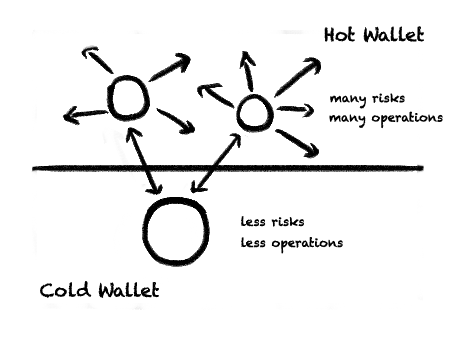
- Hot vs cold wallet — connected to the internet, or not. Hot wallets are convenient; cold storage reduces online exposure and slows down everyday use
- Multisig — requires several signatures to act. It reduces reliance on one key, but losing enough signers can block an action
- Smart contract wallet — an account controlled by code, allowing recovery options and spending limits. The code becomes an additional trust and security surface
- Account abstraction — making accounts programmable, which can soften the simple EOA/contract split. It is Further Exploration
- ENS — human-readable names like
alice.ethmapped to addresses. A name is easier to read, but still needs checking before a transfer - Derivation path — the standard by which one recovery phrase generates many keys. Using a different path can make an existing wallet appear empty
- Nonce — a per-account counter that makes each transaction unique and fixes its order. Reusing an old nonce prevents a signed transaction from simply being replayed
Guided walkthrough
Preparation only. You install the wallet in Part 7.
Decide where your recovery phrase will live
Paper, offline, somewhere you will not lose it and nobody will stumble across it. Decide before you have one — the moment you are shown twelve words is the wrong moment to improvise.
Commit to a fresh wallet
Even for testnet work, create a new one. Do not reuse a wallet holding anything real. Week 0's "separate wallets" rule starts here.
Bookmark the real MetaMask site
metamask.io — and install only from that bookmark. Fake wallet extensions in browser stores are a routine attack, and they are convincing.
Pre-commit to the pause
Every approval from now on: which network, which contract, what am I authorising. Practising it on testnet is the entire reason we use testnet.
Worked example
Two people, same mistake, different networks.
She connects to a test DApp and gets a signature request she doesn't recognise. She approves without reading — it's testnet, and she is moving fast. It was an unlimited approval on a test token. Her Sepolia balance is drained by an automated script within minutes.
Cost: nothing. The tokens were worthless.
What she got was the experience of seeing a routine-looking request, approving it, and watching a balance vanish without a further prompt. She now reads every request — and not because somebody told her to.
Same request, same reflex, real USDC. The same script runs.
The money is gone in one block. No support line exists, because there is no operator — which is the whole point of Part 1.
Same decision, same mechanism, permanently different outcome
This is why the Academy is testnet-only. Not to make things easier. Because the skill you are building is a reflex, and reflexes are built by getting it wrong somewhere it does not matter.
Further exploration — optional, not assessed
- ethereum.org — Ethereum accounts — EOAs and contract accounts precisely
- ethereum.org — Wallets — types compared, and how to choose
- ethereum.org — Account abstraction — making accounts programmable
Sources and attribution
- ethereum.org — Ethereum accounts — Reuse (CC BY 4.0), adapted
- ethereum.org — Wallets — Reuse (CC BY 4.0), adapted
- ethereum.org — Networks — Reuse (CC BY 4.0), adapted
- MyFirstNFT — Reuse (permission granted, LXDAO); hot/cold wallet visual
- MetaMask — Support — Link, referenced only