
Mechanism and market design
Week 5 · Part 3 — Mechanism and market design
Core question: what does a swap actually do to a Uniswap-style pool, and why does the size of the pool change the price you get?
An automated market maker (AMM) is a contract that calculates a swap from the tokens held in a pool instead of matching a buyer's order with a seller's order. A decentralised exchange (DEX) can use different designs; this Part works through one constant-product example. A liquidity provider (LP) deposits the pool's tokens and may receive a share of trading fees. You will calculate what one swap does to the reserves, payout and execution price, and why a deeper pool changes the result.
Picture a see-saw with two buckets
One bucket holds ETH, the other USDC. Pour ETH into one side and the pool pays you out of the other, keeping the two in balance by its rule. The more you pour in, the more the balance tilts against you.
Where the picture stops: a see-saw tilts back by itself. A pool does not. It only moves back when someone trades the other way. An arbitrageur buys an asset where it is cheaper and sells it where it is more expensive, trying to earn the difference. If ETH is cheaper in the pool than elsewhere, an arbitrageur can buy ETH from the pool and sell it elsewhere. That trade changes the reserves and can move the pool price toward the wider market.
The hard skill
Derive what a trade does to a constant-product pool from its rule, rather than from a product description.
After this Part you can:
- calculate the payout of a swap, including the fee;
- tell the starting spot price from the average price a trade actually gets;
- explain where liquidity providers' fee income comes from;
- explain why deeper pools give better prices, and what arbitrageurs do next.
Core / reference material
The rule
A simplified Uniswap v2-style pool holds reserves of token X and token Y. Let be the pool's reserve of X and its reserve of Y, measured in their respective token units. An invariant is a rule the mechanism uses to preserve or target while calculating an action. Here, the reserve product is the target used to calculate a swap's payout:
The product is the reserve-product invariant used in the payout calculation. Rearranging the same relationship gives:
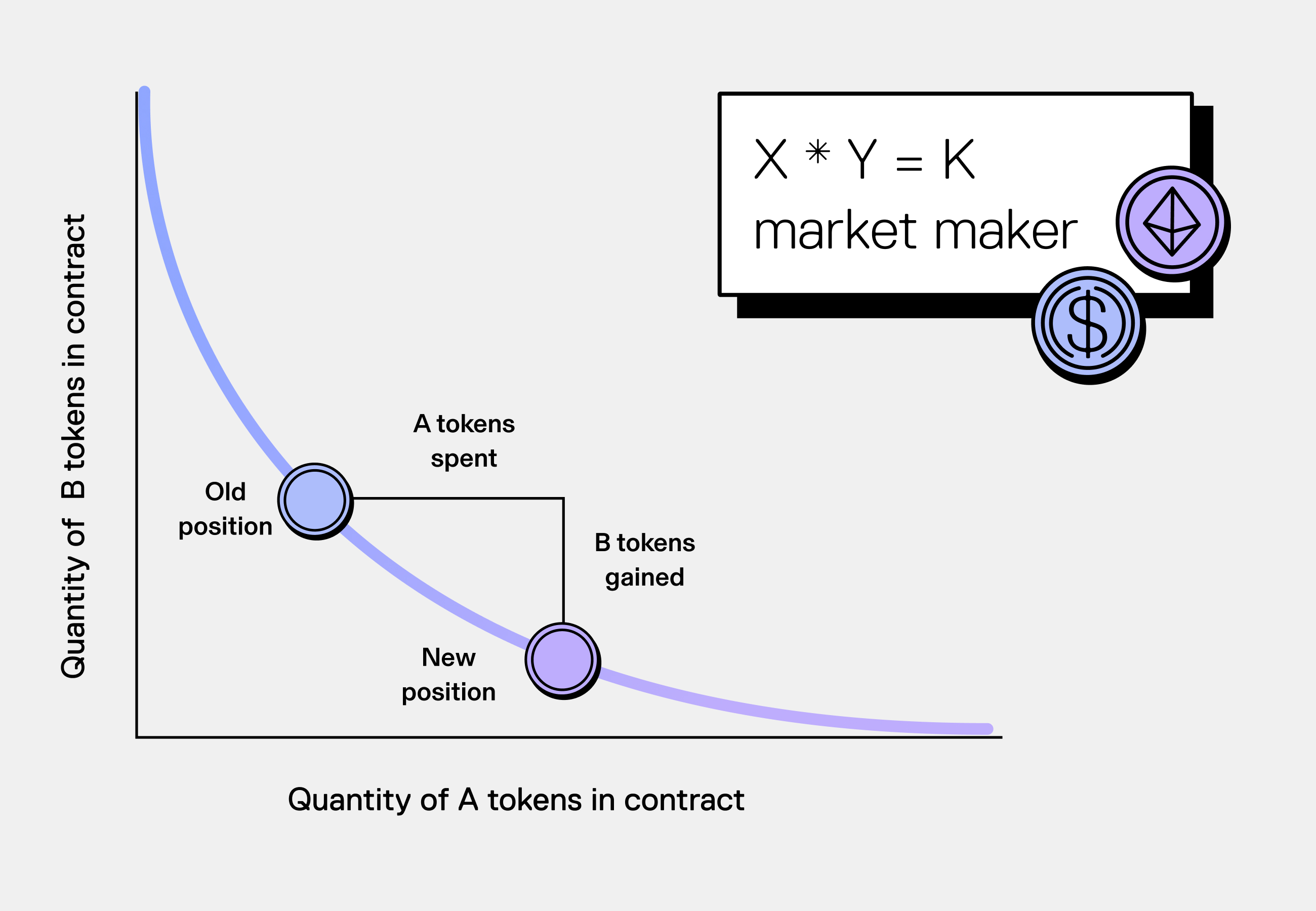
As the X reserve increases, the Y reserve must fall to keep the product at . The relationship is not a straight line: doubling halves , while equal additions to do not produce equal changes in .
These price terms describe different things in this simplified pool:
- Starting spot / marginal price: The pool's price for the next very small trade, before that trade meaningfully changes the reserves.
- Average execution price: The average price for the whole trade, total Y received divided by total X sent.
- Price impact: The price change caused by the trade itself changing the pool's reserves.
For a very small trade, the average execution price can be close to the starting marginal price. A larger trade changes the reserves more, so its average execution price becomes worse.
Suppose a trader sells X to receive Y. X enters the pool, so its X reserve increases; Y leaves, so its Y reserve decreases. As Y becomes scarcer, each additional unit of X buys less Y than the previous one. The execution rate worsens as the trade grows: this is the intuition behind price impact. A larger trade moves farther along the curve and has more price impact.
The reserve ratio gives the starting marginal price. Imagine a pool with 100 ETH and 200,000 USDC: it holds 2,000 USDC for every 1 ETH. Before a very small trade moves the reserves, that ratio is the price for a very small trade. Because the pool follows , the local change is about units of Y for each unit of X:
Here is measured in units of Y per unit of X. A finite trade changes both reserves, so its average execution price differs from the starting spot price. This is the simplified constant-product v2 model, not a formula for every AMM or DEX design.
The mental model is trade → reserves change → reserve ratio changes → marginal price changes. For pools starting at the same price, a deeper pool has larger reserves, so the same trade changes them by a smaller proportion and moves less far along the curve. That usually means less price impact.
For an input of X (measured in token X units) and fee rate (a fraction, such as for 0.3%), the fee-adjusted amount used in the payout calculation is:
The trader sends all of , but the fee portion is not used to compute the immediate output. In v2, that fee remains in the pool, so the pool's real reserve product after the trade can be slightly larger than ; this is one source of liquidity-provider fee income.
If the pool starts with reserves and , then after the effective X input the simplified new Y reserve and trader output are:
Here is the remaining Y reserve, while is the amount of Y paid to the trader. The rule keeps the reserve product at for the payout calculation: once the X reserve increases, divide by that new reserve to find the Y that must remain; the difference is the output. The units of are token X and the units of and are token Y. These expressions assume a two-reserve constant-product pool, a stated fee, and no other route or market impact.
Primary source: Uniswap v2 Core whitepaper
Read §2.1, “Constant Product Market Maker” for the reserve rule. Section 2.2 on price oracles is optional context; the calculation below is the focus.
- Open the Uniswap v2 Core whitepaper
- For protocol-authored pool and swap diagrams, see Uniswap's “How Uniswap Works”.
Read the Uniswap v2 Core whitepaper inside the Academy
Worked example: selling 10 ETH
A pool holds 100 ETH and 200,000 USDC, with a 0.3% fee.
- Starting spot price = 2,000 USDC per ETH
A trader sells 10 ETH to the pool.
- Take out the fee for the payout calculation: ETH. The pool keeps the 0.03 ETH fee, but it is not included in the effective input.
- Find the new USDC reserve. USDC.
- The trader receives what leaves the pool: 18,132.22 USDC.
- Average execution price = 1,813.22 USDC per ETH, about 9.34% below the starting spot price: . Without the fee the payout would be 18,181.82 USDC, so the fee itself cost the trader about 49.60 USDC. Most of the gap comes from the trade moving the price, not from the fee.
- K after the trade. The pool keeps the full 10 ETH, so its real reserves are 110 ETH and 181,867.78 USDC: 110 × 181,867.78 ≈ 20,005,456. That is above 20,000,000 because the 0.03 ETH fee stayed in the pool.
- The pool's new spot price is 181,867.78 ÷ 110 ≈ 1,653.34 USDC per ETH. If ETH still trades at about 2,000 USDC elsewhere, anyone can buy cheap ETH from this pool and sell it elsewhere. Those arbitrage trades put USDC back in and take ETH out, pushing the pool price back towards the market. Arbitrage can therefore bring the pool price back toward the external market without an oracle; it is not instantaneous or guaranteed.
Why deeper pools give better prices
Repeat the same 10 ETH trade in a pool twice as deep: 200 ETH and 400,000 USDC. The starting price is still 2,000 USDC per ETH.
- K = 200 × 400,000 = 80,000,000
- Effective input is still 9.97 ETH, so the ETH reserve becomes 209.97
- New USDC reserve = 80,000,000 ÷ 209.97 = 381,006.81
- USDC received = 400,000 − 381,006.81 = 18,993.19
- Average execution price = 1,899.32 USDC per ETH, about 5.03% below 2,000
| Pool | USDC received | Average execution price | Below 2,000 by |
|---|---|---|---|
| 100 ETH / 200,000 USDC | 18,132.22 | 1,813.22 | 9.34% |
| 200 ETH / 400,000 USDC | 18,993.19 | 1,899.32 | 5.03% |
Academy schematic: same initial price and 10 ETH trade; illustrative comparison, not a live quote:
A deeper pool absorbs this same trade with a smaller change in its reserve ratio. The illustration holds starting price, trade size and fee constant; pool TVL alone is not always active executable depth, especially when liquidity is concentrated into selected price ranges.
Where the v2 model stops
V2 allocates liquidity across the entire positive price range: providers do not choose an interval. V3 lets them concentrate liquidity near a selected price, so the same capital can support deeper execution within that interval. Outside it, the position becomes inactive, stops earning trading fees and may be entirely one asset. Pool TVL alone therefore does not reveal active depth.
An LP's changing asset mix also creates impermanent (divergence) loss: the position can underperform simply holding the original assets when their relative price changes. It is an opportunity-cost comparison, not necessarily a negative dollar return. Fees may offset it; “impermanent” does not promise recovery. These concepts explain the boundary of our v2 arithmetic; they add no second calculation task.
Hands-on task
A pool holds 150 ETH and 300,000 USDC, with a 0.3% fee. A trader sells 12 ETH for USDC.
- Calculate the starting K and the starting ETH price.
- Calculate the fee and the effective ETH input.
- Calculate the USDC the trader receives.
- Calculate the average execution price, and how far below the starting spot price it is, as a percentage.
- Calculate the real K after the trade, and explain why it is higher than the starting K.
- Calculate the pool's new spot price. If ETH still trades at 2,000 USDC elsewhere, who would trade with the pool next, in which direction, and what would that do to the pool's price?
- In one or two sentences, explain why the same trade would move the price less in a deeper pool.
Out of scope: concentrated-liquidity maths, impermanent-loss formulas, gas costs and multi-hop routes.
Evidence required
- Your working for each step, with the numbers you used.
- Your short answers to steps 6 and 7.
Completion and revision
This Part is worth 100 points in the Academy progression. Academy participants submit it for a binary Complete or Revise review against the criteria above. Independent readers may use those criteria as a self-check; formal points are tracked through organised Academy participation. There is no partial-score rubric.
Your work is complete when:
Further exploration: optional, not assessed
- How large a trade, in ETH, would move the 150 ETH pool's spot price by 1%? Why do aggregators split big trades across pools?
- A liquidity provider owns 10% of the pool. How much of this trade's fee is theirs, and in which token?
- Read section 2.2 of the Uniswap v2 whitepaper on price oracles. Why does Uniswap average prices over time rather than use the spot price?
- Compare an LP's fee income with divergence loss under a stated price path; range maths and the IL formula are optional depth.
Sources and attribution
- Uniswap v2 Core whitepaper (Link, referenced only)
- Uniswap: What is an Automated Market Maker? (source for an attributed third-party teaching figure; original ownership remains with its rights holder and it is not covered by the Academy content licence; only blank left margin cropped, labels and axes retained)
- Uniswap docs: v2 pricing (Link, referenced only)
- Uniswap: Concentrated liquidity (protocol documentation, checked 26 October 2026)
- Uniswap v2: Understanding returns (protocol documentation)