
Collateral, credit and DeFi economics
Week 6 · Part 1 — Collateral, credit and DeFi economics
Core question: at what price does a crypto loan get liquidated, and what happens to the lender if the market moves faster than that?
A lending protocol is one kind of decentralised finance (DeFi) system: it lends to users without a conventional credit check. All it has is the collateral they deposit and a rule for when to sell it. In this Part you turn that rule into numbers: how safe a loan is now, the price where it gets liquidated, and how a wrong price feed can leave the protocol with a loss. A lending pool is the shared supply of assets users put in so other users can borrow them.
- Collateral: An asset you put up as backing for a loan.
- Debt: What the borrower currently owes, including any interest due under the protocol's rules.
- Borrower: A user who takes assets from the lending pool and must repay them under the protocol's rules.
- Supplier: A user who puts assets into the lending pool so others can borrow; the supplier may receive part of the interest.
- Liquidation: A protocol process that lets part of the borrower's collateral be used to repay some debt after a position crosses a risk boundary.
- Liquidator: A user or bot that carries out this process under the protocol's rules.
Picture a pawn shop
You leave a watch and borrow less than it is worth. If the watch's value falls too close to what you owe, the shop sells it before it is worth less than the loan.
Where the picture stops: the shop can look at the watch. A protocol cannot. It relies on a price feed it reads from the chain, and if that feed is late or wrong, it acts on the wrong number.
The hard skill
Model how a lending protocol uses collateral, a liquidation threshold and a price feed to decide when a loan fails, and trace what happens when it acts too late.
After this Part you can:
- calculate a health factor;
- solve for the liquidation price, and the fall needed to reach it;
- tell the liquidation price from the break-even price;
- trace a path from a market move to a possible loss for the protocol.
Core / reference material
Primary source: Aave V3 Technical Paper
The paper explains Aave V3's design reasoning and architecture. Read the sections on health factors, liquidations and interest-rate design alongside the model below. It is a design paper, not a current runtime specification: deployments and parameters can change. For present behaviour, check Aave's current documentation on health factors and liquidations, interest-rate strategy, reserve parameters and E-mode.
- Download the Aave V3 Technical Paper (official PDF)
- View the PDF in the official Aave DAO repository.
Read the Aave V3 Technical Paper inside the Academy
The embedded PDF is an unmodified reading copy of the official paper. Use the current Aave documentation linked above for present behaviour.
Borrowing limit and liquidation boundary are different
Loan-to-Value (LTV) and Liquidation Threshold (LT) serve different roles. Aave reserve settings vary by asset and market; these terms are a conceptual guide, not a live borrowing recommendation.
- LTV — borrowing-capacity limit: how much debt the collateral can support when a learner borrows or increases a position.
- Liquidation Threshold (LT) — liquidation boundary: the parameter used to determine when a position may become eligible for liquidation.
For a simplified single-asset example, $100 of collateral with 75% LTV may support roughly $75 of borrowing. That does not mean liquidation starts at $75: a separate 80% LT sets the health-factor boundary. Actual limits depend on current reserve settings, and multi-asset positions use weighted values and protocol-specific configuration.
The health factor
A common measure is the health factor (HF). Read it as safety-adjusted collateral value divided by debt. A protocol does not count the full market value of collateral as safe backing: multiplying by its liquidation threshold sets the fraction it counts toward the liquidation boundary. In the simplified single-asset model used here:
Here, is the current collateral value in the protocol's valuation currency (USD in our examples); is the liquidation threshold, a fraction (80% is ); and is debt value in the same currency. Thus is unitless. A higher HF means more buffer. is the simplified boundary; under Aave's model, a position may become eligible for liquidation below 1. Real multi-asset positions use protocol-specific valuation and threshold rules. This health-factor formula uses LT, not LTV.
Solve for a single-asset liquidation price
If a borrower has units of one collateral asset, fixed debt , and a fixed threshold , set and solve for the price:
is the liquidation price, in currency per collateral unit (USD per ETH here); is the collateral quantity, so multiplying it by the per-unit price gives a value in currency. The formula assumes one collateral asset, unchanged debt and threshold, and that the protocol's oracle price matches the price used in the calculation. It omits interest, liquidation bonuses, fees and changing collateral. It is not the break-even price: break-even is where collateral value equals debt.
Where the price comes from
To value the collateral, the protocol needs an ETH price. It does not ask the borrower. It reads an on-chain price feed, often from an oracle network such as Chainlink.
If that price is stale, delayed or wrong, the health factor is wrong too. A price that is too high delays liquidation and can increase the chance of bad debt: a loan balance that remains unpaid because available collateral is worth too little, cannot be sold for enough, or cannot be realised in time. A liquidation may repay a loan in full; the borrower's loss of collateral is not itself protocol or supplier bad debt. A price that is too low makes a healthy position look weak. Protocols watch how fresh the feed is and build in safeguards.
Worked example: 10 ETH backing a 12,000 USD loan
A borrower deposits 10 ETH at 2,000 USD per ETH, owes 12,000 USD, and the liquidation threshold is 80%.
- Collateral value = 10 × 2,000 = 20,000 USD.
- Health factor = (20,000 × 0.80) ÷ 12,000 = 1.33. Above 1, so there is a buffer.
- Liquidation price:.
- The fall needed = 25%.
Why liquidate before the collateral is worth less than the debt?
At 1,500 USD the 10 ETH is still worth 15,000 USD, more than the 12,000 USD debt. The protocol acts early on purpose.
The break-even price is 12,000 ÷ 10 = 1,200 USD. There the collateral is worth exactly the debt. Below it, selling all the collateral would not repay the loan. If the market falls through 1,200 before a liquidation completes, for example because the price moves too fast, the oracle lags or the network is congested, unpaid debt may remain.
| ETH price | Collateral value | Health factor | What it means |
|---|---|---|---|
| 2,000 | 20,000 | 1.33 | Above the threshold |
| 1,500 | 15,000 | 1.00 | At the boundary |
| 1,200 | 12,000 | 0.80 | Collateral = debt |
| 1,100 | 11,000 | 0.73 | Collateral < debt |
Academy schematic: a conditional lending failure path, not a claim that every liquidation produces bad debt:
The diagram separates a borrower's liquidation loss from protocol bad debt. Eligibility does not guarantee that a liquidator acts in time; a liquidation shortfall can expose suppliers or the protocol only if its accounting and loss rules leave debt uncovered.
The liquidation price is not a second market price. The market price moves; the liquidation price is the trigger level set by the position's collateral, debt and threshold.
The economic feedback: utilisation and interest
Utilisation asks what share of supplied assets is currently borrowed. In the simplified reserve model here, the utilisation rate is:
Both quantities refer to the same reserve and asset; is a fraction, often shown as a percentage. If 80 of 100 units supplied are borrowed, and 20 units remain as the simple withdrawal buffer. High utilisation means less immediately available liquidity relative to supplied assets; borrowers pay for access to scarcer liquidity. Supplier yield generally depends on borrow rates, utilisation and the protocol's retained share. Some protocols give suppliers extra tokens to encourage them to provide assets. This extra reward is a subsidy. It is separate from interest generated by borrowers, and it can stop even while a loan remains.
Aave V3's official interest-rate strategy models the variable borrow rate as two linear regions around an optimal-utilisation level. The target and rate parameters are set per reserve, so the historical figure below illustrates the shape rather than today's settings for a particular market.
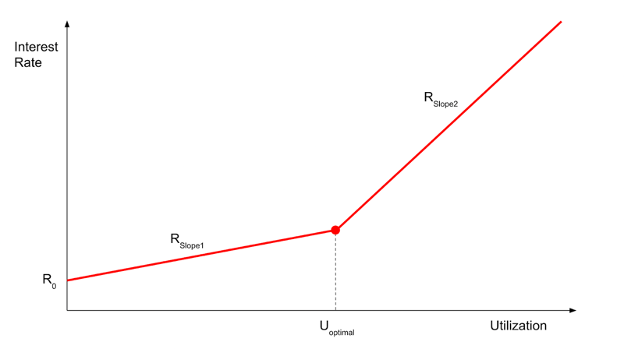
The horizontal axis is reserve utilisation; the vertical axis is borrower interest rate. Aave's current V3 documentation describes this as a piecewise two-slope model. In these simplified formulas, is the variable borrow rate; is utilisation as a fraction; is the target level; is the starting rate; and the slope terms describe how much the rate rises in each region. Rates and parameters are configured separately for each reserve.
At or below optimal utilisation:
Before the target, the borrow rate rises gradually as more supplied liquidity is borrowed. At the target, this first region has added the full contribution.
Above optimal utilisation:
After the target, the model adds the steeper second slope. As utilisation approaches 100%, borrowing becomes more expensive much faster because less liquidity is immediately available. These formulas explain the graph; they are not parameters to memorise or a live rate quote.
The intended feedback is:
More borrowing → higher utilisation → less immediately available liquidity → higher borrow rates, especially beyond the target → stronger incentives to reduce debt and provide liquidity → utilisation may move back toward the target.
Higher rates create incentives for borrowers to repay or reduce borrowing, and higher supplier returns may attract new liquidity after the protocol's share. These are not guaranteed responses: borrowers and suppliers may react differently depending on market conditions, alternatives and their sensitivity to rates. A mechanism is designed to influence behaviour, not control it.
Recursive borrowing means borrowing against collateral and redepositing or buying more collateral to borrow again. Gross supplied assets and debt grow together while initial equity does not. Yield exposure, borrowing cost and liquidation exposure all grow; a subsidy can disappear before the debt does. The same HF model still asks what collateral and debt the protocol actually values.
Landscape: Pendle, separating principal and future yield
Principal is the original amount or claim. Yield is the additional value that amount may produce over time. Pendle represents these two ideas with PT, the principal-side claim, and YT, the yield-side claim up to maturity.
A yield-bearing asset is a position that may earn extra value over time, for example staking rewards or lending interest. Pendle splits the position into two claims that end on a set date, called maturity. Think of a rental property: one claim is to the property later, and another is to rent produced up to a stated date. This is only an analogy; PT and YT are crypto-token claims, not legal ownership of a house.
Pendle's Standardized Yield (SY) is a behind-the-scenes wrapper for handling different yield-bearing assets. The useful distinction is what the two tokens let their holder claim.
PT: principal later, with no payments along the way
A Principal Token (PT) can be redeemed at maturity in the market's named accounting asset. This is the unit Pendle uses to state what the PT claim represents and what it redeems into. Check the market label: it may not be the same as one whole yield-bearing token. PT holders do not receive the yield earned during the term.
Pendle compares PT to a zero-coupon bond. A bond is an IOU that can be bought and sold; a zero-coupon bond pays no regular interest, and if it is repaid as promised, the holder gets a stated amount at the end. Suppose a Pendle market says one PT can be redeemed for one unit of its accounting asset, and the PT costs 0.95 units today. If you hold it until maturity and redemption works, the 0.05 difference is the possible gain before costs. Nothing is paid while you wait. This is an analogy, not a guarantee or a claim that PT is a government or company bond: its market price can move, and redemption still depends on the protocol and asset. PT can also be sold before maturity, but its market price may be different from both the price you paid and the later redemption amount.
YT: whatever yield is actually produced before the date
A Yield Token (YT) gives its holder the yield that one unit of the market's accounting asset actually produces before maturity. Using the rental analogy, YT is a claim to the rent that really arrives, not a promise that the property will earn a particular amount. If the yield source produces little or no yield, the YT claim can also be small or zero.
APY, or Annual Percentage Yield, expresses a yield as a one-year percentage rate so rates can be compared more easily. An 8% APY does not guarantee that the asset will earn exactly 8% over the next year.
Pendle uses two APY ideas that are easy to mix up:
- Underlying APY: Pendle's recent-yield indicator for the underlying asset. Its glossary defines this as a 7-day moving average, so it describes recent yield, not exactly what the asset will earn through maturity.
- Implied APY: the future average yield rate currently priced by the PT/YT market. Pendle derives it from the relative YT and PT prices; it reflects current market pricing, not a rate Pendle guarantees.
If the market displays an 8% Implied APY, it does not mean the asset will definitely earn 8%. The relative PT/YT prices currently reflect a market-priced view around that future average rate. The actual yield through maturity may be higher, lower or zero. A YT holder receives only the yield actually produced; whether the position works out better or worse than its current price suggests also depends on the purchase cost and time remaining. YT is exposure to uncertain future yield, not fixed interest.
The four basic actions
Pendle's linked beginner guide and minting guide show the protocol's own lifecycle illustrations. In plain language:
- Mint before maturity: deposit a yield-bearing asset to create PT and YT.
- Redeem before maturity: combine matching PT and YT to recover the associated yield-bearing asset.
- Claim yield before maturity: YT holders can claim yield that has already accrued; future yield is still uncertain.
- Redeem PT after maturity: PT can be redeemed without YT for the accounting asset stated by that market. YT no longer earns new yield.
Academy schematic: simplified tokenisation flow, not Pendle contract architecture. For Pendle's own illustrated beginner explanation, see the Pendle Academy chapter on yield tokenization and the protocol's minting documentation. These explain the protocol's lifecycle; the schematic above is only an orientation aid. Neither PT nor YT removes contract, liquidity, oracle, maturity or underlying-asset risk.
If a lender accepts PT as collateral, it composes another dependency chain: underlying asset → yield protocol → SY/PT settlement → lender's valuation and liquidation rules. Maturity does not remove contract, liquidity, oracle or underlying-asset risk. This is recognition material, not a borrowing strategy or a second assessed task.
Researcher takeaway: identify which token represents principal and which represents yield, what changes at maturity, and what extra protocol, liquidity, oracle and maturity dependencies appear if a yield-derived asset is accepted as collateral.
Hands-on task
A borrower deposits 8 ETH when ETH is 2,500 USD. The debt is 10,000 USD and the liquidation threshold is 80%.
- Calculate the collateral value and the current health factor.
- Calculate the ETH price where HF reaches 1.
- Calculate the percentage fall from 2,500 USD to that price.
- Find the ETH price where the collateral is worth exactly the 10,000 USD debt.
- The market price is 1,400 USD, but a stale oracle still reports 1,700 USD. Calculate the HF using each price, and explain the risk.
- Write the failure path in four to six short steps, from "ETH falls fast" to "the protocol is left with a loss". Name who bears the loss.
Out of scope: live rate calibration, liquidation bonuses, executing leverage or Pendle strategies, and specific Aave market parameters. All numbers above are hypothetical; use a worksheet, not funds or wallet actions.
Evidence required
- Your working for steps 1 to 5.
- Your failure path from step 6.
Completion and revision
This Part is worth 100 points in the Academy progression. Academy participants submit it for a binary Complete or Revise review against the criteria above. Independent readers may use those criteria as a self-check; formal points are tracked through organised Academy participation. There is no partial-score rubric.
Your work is complete when:
Further exploration: optional, not assessed
- The borrower adds 1 ETH of collateral at 2,500 USD. What is the new liquidation price?
- Look up how often the Chainlink ETH/USD feed updates. How far could the price move between two updates?
- Find a real bad-debt event on a lending protocol. Which step of your failure path broke?
- Compare a funding-rate/basis trade or a recursive PT lending loop as a dependency model only: what borrowing, settlement and funding assumptions could fail together? No position, return forecast or trade is required.
Sources and attribution
- Aave DAO: Aave V3 Technical Paper (official source for the unmodified local reading copy; design reference, not a current deployment specification)
- Gauntlet: Extending support for Interest Rate Curves (attributed third-party figure; original ownership remains with its rights holder and it is not covered by the Academy content licence; unmodified historical Aave governance illustration, 25 October 2022, not current reserve parameters)
- Aave: Health factor and liquidations (Link, referenced only)
- Chainlink: Price feeds (Link, referenced only)
- Aave V3: Interest rate strategy (protocol documentation)
- Aave: Reserve parameters and Efficiency Mode (current protocol documentation; verify the selected market and date)
- Pendle: Principal token (Link, protocol documentation)
- Pendle Academy: Yield Tokenization Basics and Pendle: Minting (official lifecycle references; illustrations are linked, not reproduced)
- Pendle: Yield tokenization architecture (protocol reference; the linked Pendle Academy illustrations are not copied)
- Pendle: Glossary (Link, protocol documentation)